
Moira Deeming’s Children in Brothels Motion
In the last sitting week of this term of parliament, the Upper House of the Victorian Parliament voted against [7] MP Moira Deeming’s ‘children in brothels’ motion. [6] The motion calls for new criminal penalties to be introduced for people who allow children into brothels or residential properties where home based sex work is occurring.
Who is Moira Deeming?
Elected to Victoria’s state parliament in 2022, Moira Deeming was a controversial Liberal MP and is now candidate for the Family First party.
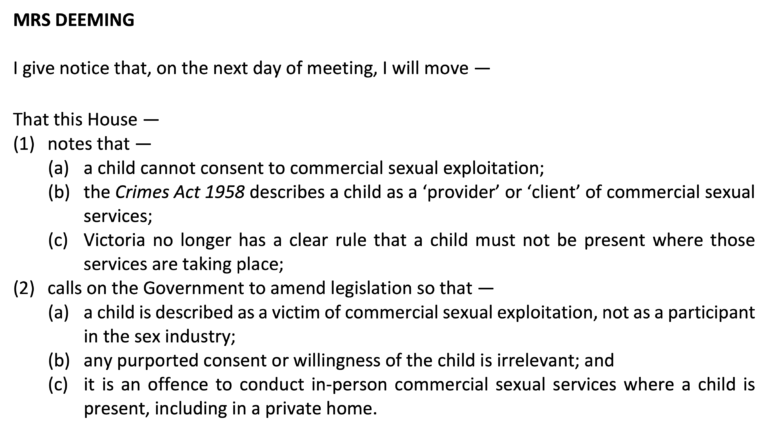
Read Mrs Deeming’s Sex Industry Motion
Read a press release from Family First about this motion here.
The Motion Explained
Members of parliament can make a proposal to the parliament to be voted on by other members of the parliament. This is known as a notice of motion. A notice of motion is not the same as a new law or bill. A motion is a broader ‘idea’ or proposal which usually lacks the detail of a new law or bill. Politicians have the chance to speak or debate the merits of each motion, and then vote on it. Motions are voted on by the parliament on most parliamentary sitting days. As an example, you can read a list of motions from a single day in parliament in 2026 here.
To read the debate of Moira Deeming’s motion, see pages 61–71 of Hansard for the Upper House for 23 September 2026.
Moira Deeming’s motion contains two clauses. Clauses 1 and 2(a)-(b) seek to change the language, but not the function of existing criminal laws. Some members of parliament believe the language of the law matters symbolically. In these clauses, Mrs Deeming is proposing stronger language be introduced into existing criminal laws, which would make it explicitly clear that children exploited in the sex industry are always victims. This is a stylistic proposal, as it would not change the penalties or the application of the law. It would only change the language used to describe crimes already in legislation.
Clause 2(c) of Mrs Deeming’s motion proposes inserting brand new offences. The debate in parliament on 23 September 2026 about this motion revealed confusion about what exactly is currently prohibited by Victorian criminal laws. There are three separate and distinct scenarios the law can apply to: (a) sexual exploitation of a child, (b) sexual activity in the presence of a child and (c) allowing a child to be present at a place where sex work occurs.
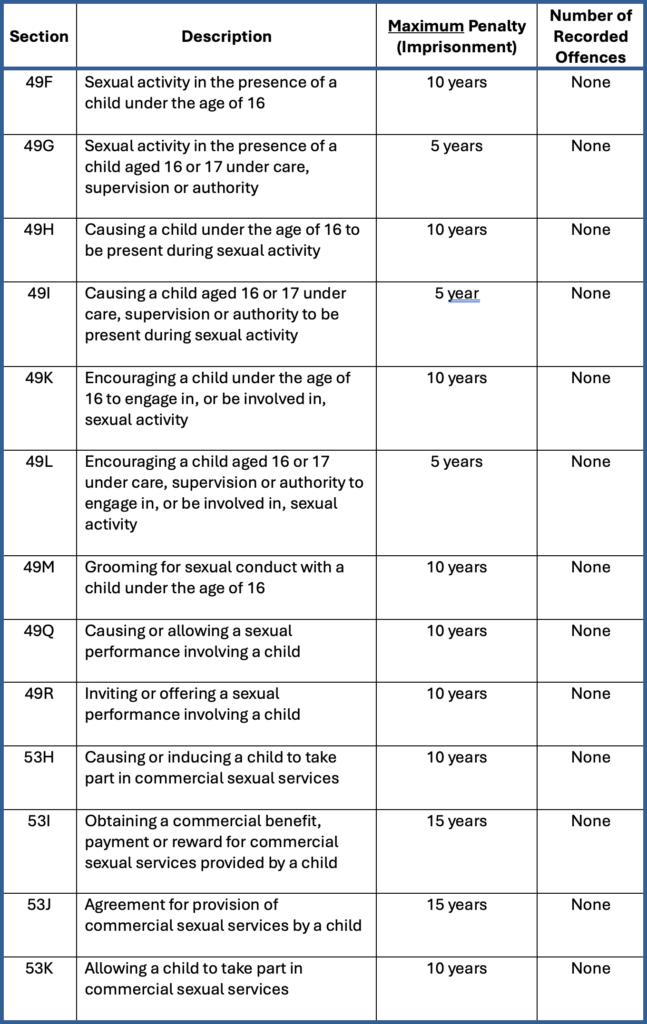
Sections 49Q, 49R, 53H, 53I, 53J and 53K of the Crimes Act 1958 prohibit children from being directly involved in the stripping or sex industries. It is a crime to pay a person under 18 for sex; sexual exploitation of children in the sex industry is a serious crime and has been prior to sex work being decriminalised. Clause 2 of Moira Deeming's motion does not seek to change these laws, as existing laws already outlaw child exploitation in the sex industry.
Sections 49F, 49G, 49H and 49I of the Crimes Act 1958 define the crimes of sexual activity occurring in the presence of a child. In these sections, the sexual activity is not confined to the sex industry. Sexual activity, whether commercial in nature or not, must not occur in the presence of a child. The scenario of sexual activity occurring in the presence of a child is already a crime in Victoria.
Clause 2 of Moira Deeming's motion does not seek to change these laws, as existing laws already outlaw exposing children to sexual activity.
Section 38C of the Summary Offences Act makes it a crime to permit a child between the ages of 18 months and 18 years to be in a brothel, including in the rooms where sexual activity does not occur. Anywhere in the brothel premises the child is not permitted.
There is no law prohibiting a child under the age of 18 months being in a brothel. This is not new. Since 1994, Victoria’s previous sex work laws permitted children under the age of 18 months to be inside brothels. The law applying to this particular scenario did not change when sex work was decriminalised.
Moira Deeming considers this legal situation to be a dangerous legal loophole, which exposes babies to an unacceptable risk. Clause 2 of her motion seeks to close this legal loophole.
There are no existing criminal laws prohibiting a child under the age of 18 from being present in residential properties or hotels/motels where sex work occurs. ‘Present’ doesn’t necessarily mean the child is in the same room as where the sex work is occurring. The child could be in a room next door.
However, civil laws may apply to this scenario with Child Protection having the authority to take action against parents who allow children to be in residential properties where sex work occurs.
Moira Deeming considers this legal situation to be a dangerous legal loophole, which exposes children to an unacceptable risk. Clause 2 of her motion seeks to close this legal loophole.
Yes. Tasmania prohibits children from residential properties where sex work occurs (section 11 of the Sex Industry Offences Act 2005 (TAS)). Tasmania has not decriminalised sex work. Brothels are illegal in Tasmania, so there is no prohibition on children being in brothels in Tasmania.
Victoria’s Sex Industry: Brothels and Home Based Sex Work
In 2023, Victoria decriminalised sex work, a move heralded by myself and sex workers across Australia. Brothels and erotic massage parlours can now legally operate in commercial and mixed use zones, subject to the same planning restrictions as other ‘shops’.
Individual sex workers who don’t work in a brothel often work from their place of residence, and this is now also legal provided the sex worker’s business falls within the definition of ‘home based business’. This form of sex work, known as home based sex work, is actually a very common, yet largely invisible form of sex work. Home based sex work is legally NOT classified as a brothel. It is classified under planning schemes as a type of ‘home based business’.
Amenity complaints about brothels, erotic massage parlours or home based sex work can now be directed to councils, rather than the police.
Brothels, Home Based Sex Work and Children
“I have never heard a sex worker want the law to permit children to be in brothels or residential properties where sex work occurs.”
Sex workers shouldn’t be stereotyped according to our chosen occupation. We have full lives outside of our work; hobbies, university/TAFE, volunteering, family, children, holidays, places of worship…..
I am not aware of councils, police or sex workers reporting problems of children being permitted into brothels or homes where sex work occurs.
During my 2021 Monash University consultation leading up to the decriminalisation of sex work, the consultation team heard from many sex workers, including those who were mothers. The sex workers we heard from wanted lots of changes to their working conditions. I have never heard a sex worker request laws to permit children inside brothels or residential properties where sex work occurs.
In short, sex workers are already keeping children away from sex work and there is no desire for these good child safeguarding practises to change.
Does the Law Already Protect Children from Sex Work?
Existing Criminal Offences
There are a number of criminal offences relating to children being exploited in the sex industry or being exposed to sexual activity in general. In other words, criminal laws already largely capture the types of scenarios which are the subject of this motion. No Victorian state offences relating to children in the sex industry or children being exposed to sexual activity have been recorded by police. [5]
Existing Civil Penalties
If parents expose their children to sex work occurring in a residential property, this is something which could be reported to the Child Protection division of the Department of Families, Fairness and Housing. Following reports of a child being harmed by parents, Child Protection can investigate and in some cases make an application to the Children’s Court to have the children removed from the care of the parents.
Stigma of Sex Workers
There is no evidence that children are being exposed to sex work in houses or brothels in Victoria, let alone sexually exploited in the sex industry in those setting. So there is not a strong case for Moira Deeming’s motion. This motion seeks to fix a problem which doesn’t exist, based on available criminal offending data.
My Position on Moira Deeming’s Sex Industry Motion
"I believe MP’s who vote against this motion will not look good"
I have mixed feelings about this motion; ultimately I don’t have any major issues with the motion. On the one hand, I do not support this motion, as it stigmatises the sex industry and is unnecessary. But neither do I oppose it. I believe MP’s who vote against this motion will not look good and will give opponents of the sex industry an additional weapon. This is especially the case given that earlier in 2026 the Victorian Upper House bizarrely voted in favour of giving registered sex offenders the legal right to work in the sex industry and stripping industries. I argued, and still argue, that the ‘pro registered sex offender’ vote was a terrible look for the MP’s who chose to support registered sex offenders.
This motion seeks to fix a problem which doesn’t currently exist. I’m not aware of any sex workers who want the right to bring children into brothels or have children present where home based sex work is occurring.
However, there might be some benefit to having a clear legal demarcation between the sex industry and children. Criminal laws are not in place for good folk with common sense; they are in place for those that lack common sense and decency. In the longer term, explicitly prohibiting children from sex industry settings may ease the anxiety some in the public may have regarding children being exposed to sex work. I appreciate the fact this motion has been worded to target the specific behaviour of concern, rather than applying broader industry wide prohibitions.
What Do Sex Workers’ Rights Groups Say?
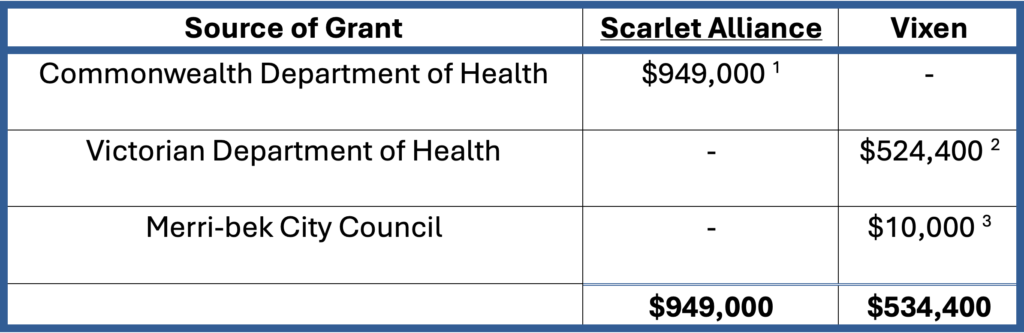
Nothing to date. Vixen and Scarlet Alliance are unrepresentative sex workers’ organisations with operations in Victoria. Vixen is unrepresentative because it has no members, and never has since its founding in 2005. Scarlet Alliance is unrepresentative because its 117 members represent just under 0.5% of the 25,000 sex workers in Australia. [4]
Both of these organisations receive generous government grants.
Both organisations say they do advocacy, policy and law reform work. Despite this, to date, neither organisation has publicly commented on this sex industry motion or the issues it raises.
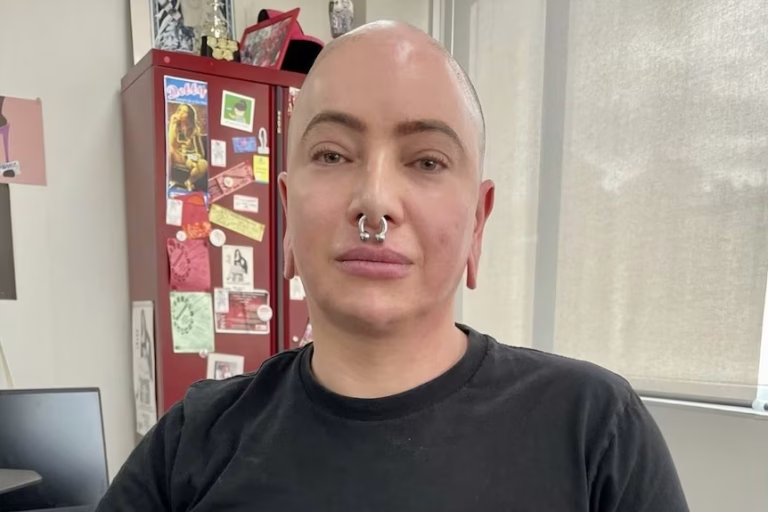
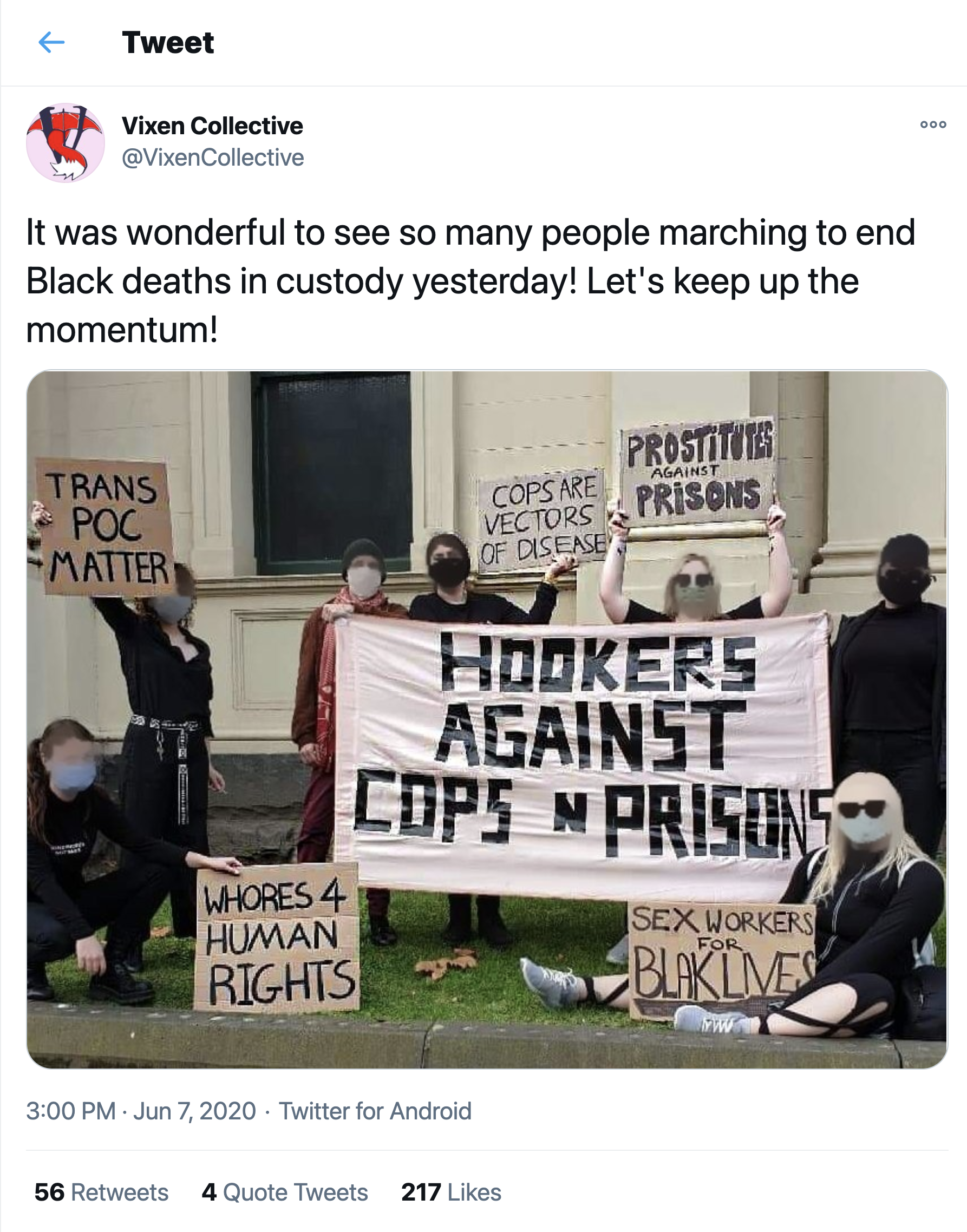
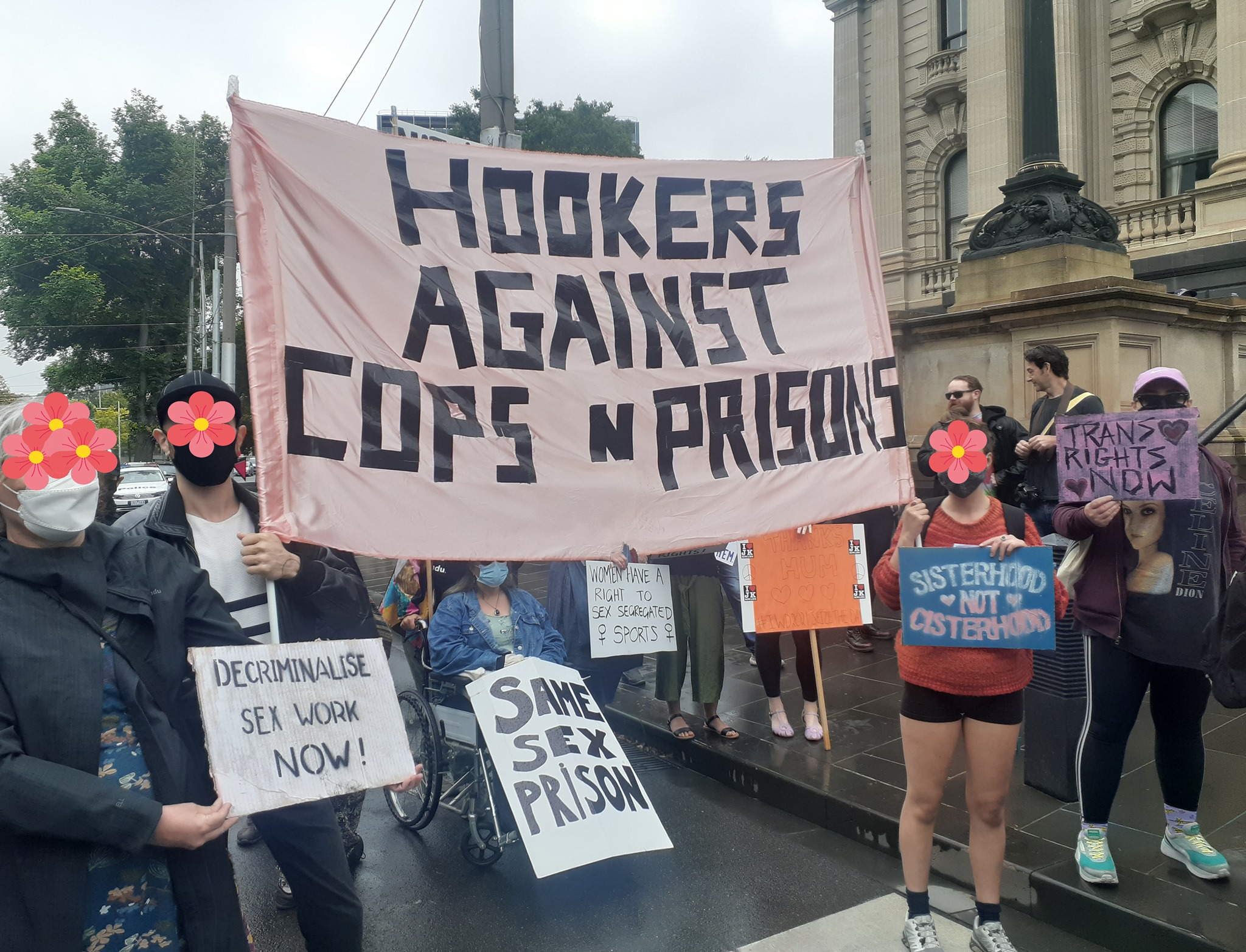
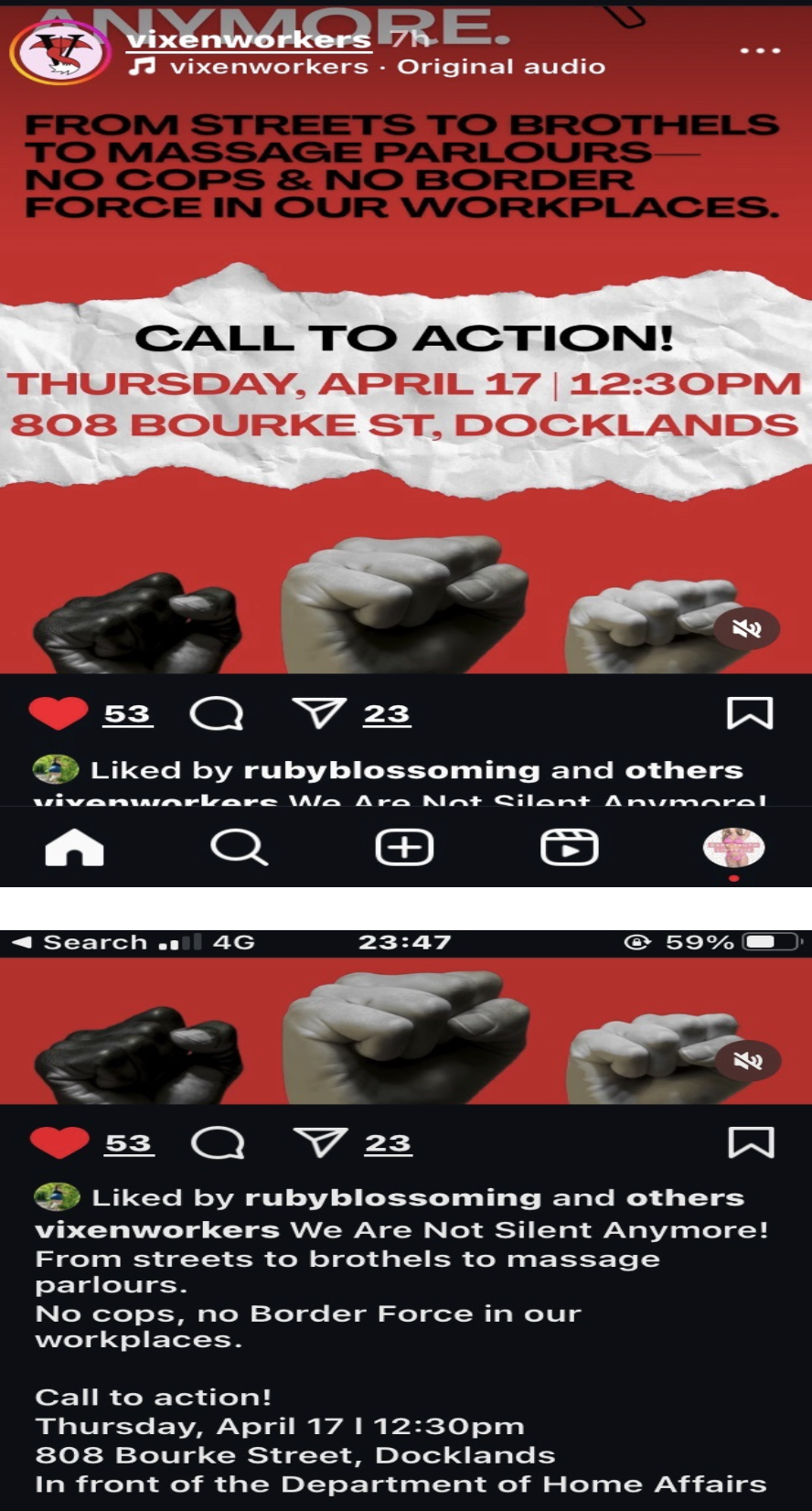
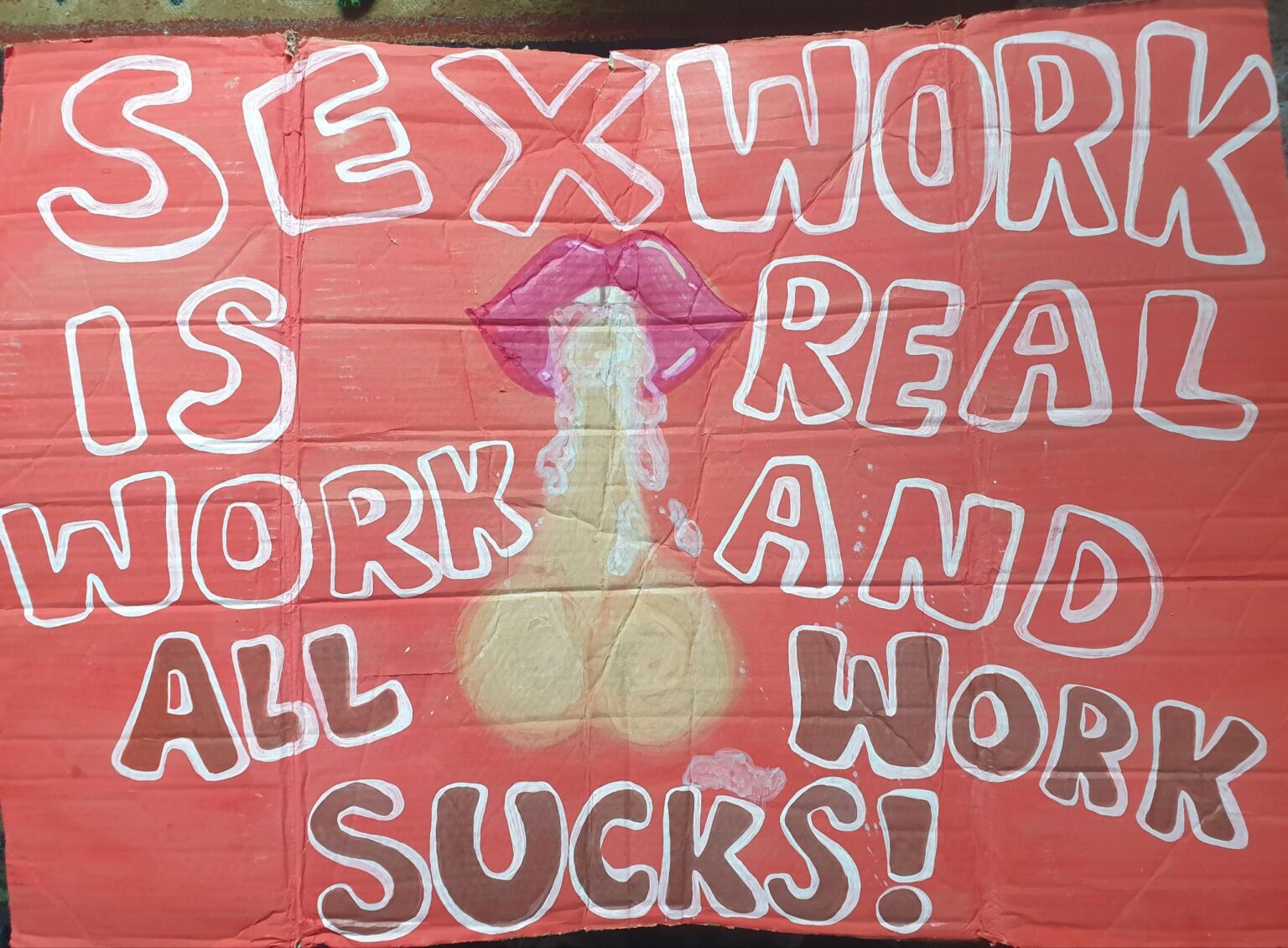
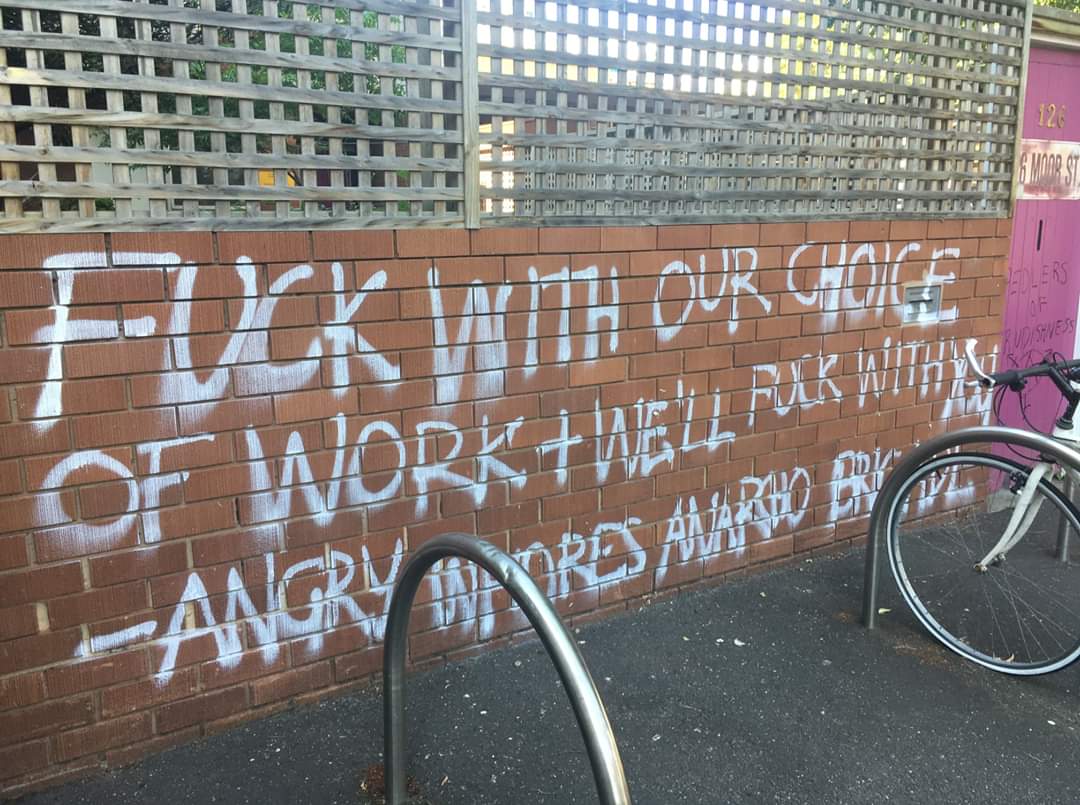
These sex worker groups are bitterly opposed to capitalism, private enterprise, the police, prisons and the concept of ‘work’. I expect these groups will oppose this motion not because of their view on children, but because of their irrational hatred of police and their ideological opposition to any police powers over the lives of sex workers. These extreme ideological positions are out of touch with the views of most sex workers in Australia.
In the past these groups have demonstrated a high degree of influence over Labor and Greens MPs.
Scarlet Alliance and Vixen’s Extreme Views Do Not Align with Most Sex Workers
What Next?
This motion was defeated by a vote in the Upper House on 23 September 2026, with the Greens and Labor opposing the motion.
Victoria’s sex work laws (which decriminalise sex work) are due to be reviewed in the next few years. It is likely the issue of the law permitting children into places where sex work occurs will be raised as part of that review.
While Moira Deeming has a longstanding habit of talking about the sex industry in a disrespectful and stigmatising manner, she has raised a concern about child safeguarding which is probably shared by others in our community. In the interest of preserving Victoria’s sex work decriminalisation laws, child safeguarding concerns must be properly addressed. Ignoring these child safeguarding concerns will likely expose the sex industry to attack from critics who seek to wind back hard fought sex work decriminalisation laws.
The Victorian state election will be held on 28 November 2026. There is a real possibility of a change of government at this election, with any new government likely to be less favourable to sex workers’ rights.
See p74 of the 2025 Scarlet Alliance Annual Report.
https://scarletalliance.org.au/wp-content/uploads/Scarlet-Alliance-Annual-Report-2024-2025.pdf
2. Ibid.
3. See Merri-bek's Successful Annual Grants for 2025-2026, Organisational Support Grant
https://www.merri-bek.vic.gov.au/my-council/grants-and-awards/community-grants-program/annual-grants/#autoAnchor1
4. In 2022 Scarlet Alliance reported having 117 individual members. In 2024 their CEO, Mish Pony revealed that the committee has a policy of no longer revealing membership numbers.
5. The Crime Statistics Agency (CSA) publishes recorded offences. The CSA does not list individual offences with zero recorded offences. None of the offences listed in this table appear on the CSA's website. This means we can conclude there are zero offences recorded for these offence codes.
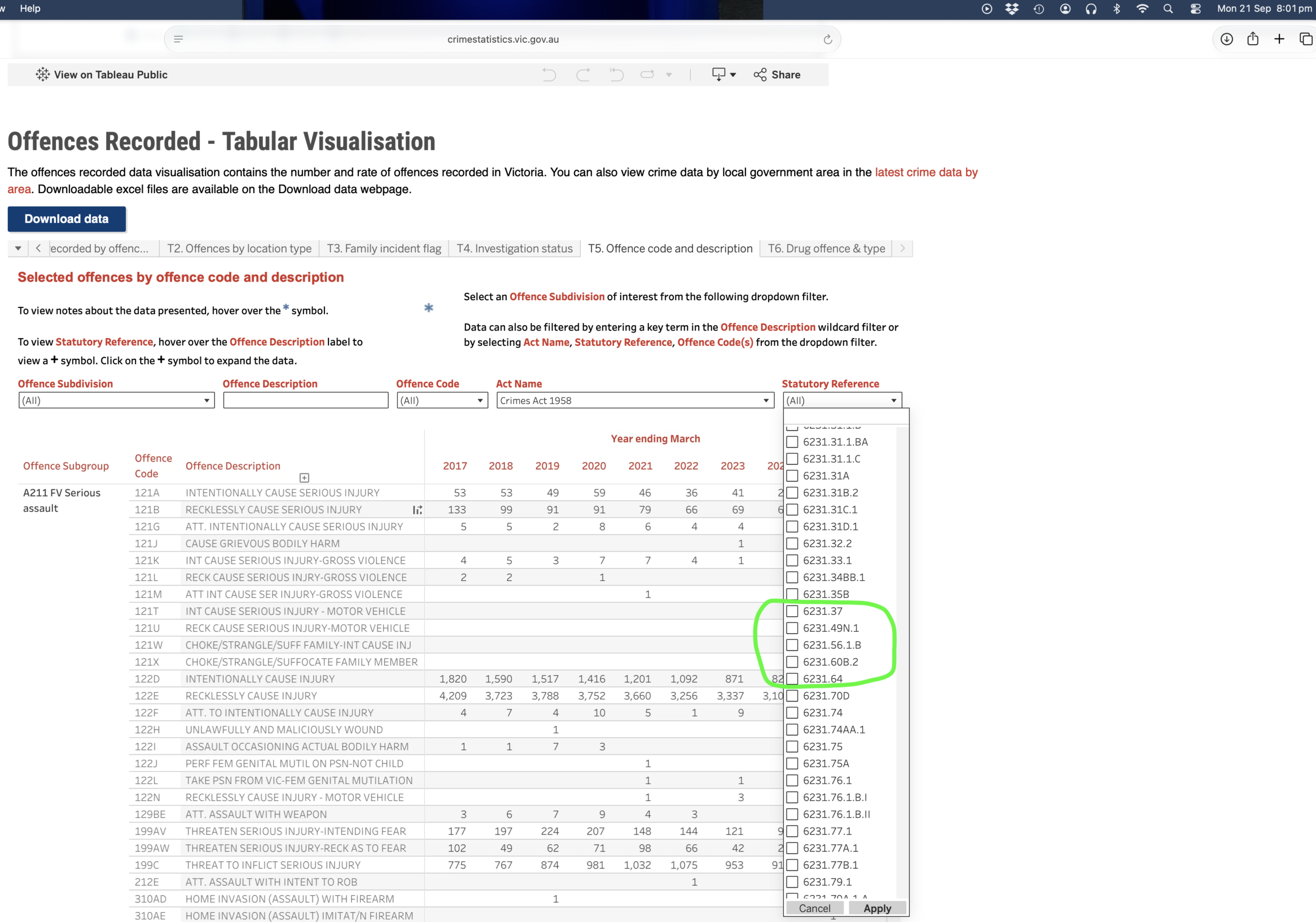
Check the data for yourself. Go to the CSA 'Recorded Offences' webpage:
https://www.crimestatistics.vic.gov.au/crime-statistics/latest-victorian-crime-data/recorded-offences-2
Scroll down to 'Offences Recorded - Tabular Visualisation' and click on 'T5 Offences by Offence Code and Description'. Then choose Act Name 'Crimes Act 1958'. Then click on the 'Statutory Reference' Drop down menu to find the individual sections.
6. See item 1645 on page 4 of the LEGISLATIVE COUNCIL NOTICE PAPER No. 187 for Wednesday, 23 September 2026
https://www.parliament.vic.gov.au/4a769d/globalassets/house-paper-documents/house-paper-7253/np187.pdf
7. See Item 13 of the LEGISLATIVE COUNCIL MINUTES OF THE PROCEEDINGS for No. 188 — Wednesday, 23 September 2026
https://www.parliament.vic.gov.au/4a76a1/globalassets/house-paper-documents/house-paper-7255/m188.pdf
8. Ibid. At the time of the vote for Moira Deeming's motion, 39 members were present in the Upper House chamber. The motion was negatived with 17 votes for and 22 votes against.
https://www.parliament.vic.gov.au/4a76a1/globalassets/house-paper-documents/house-paper-7255/m188.pdf
Artificial intelligence was not used for the background research, text, charts or images on this webpage.
Last updated: 27/09/26
Webpage created on: 22/09/26