
Sex Work Laws in Australia
Australia has gone further than almost any country in progressing the legal rights of sex workers. Each state/territory has different sex work laws. There are four separate indicators of sex workers’ rights in the law:
1. Sex work decriminalisation laws;
2. Anti-discrimination laws;
3. Local government planning scheme laws;
4. Sexual consent/stealthing laws.
From a sex workers’ rights perspective, optimum laws:
1. Decriminalise sex work;
2. Provide sex workers with anti-discrimination law protections based on occupation or sex work status;
3. Enshrine local government planning scheme laws which recognise and treat sex work like other similar service businesses such as hairdressers;
4. Sexual consent laws recognise the fraudulent non payment of sex work service fees as sexual assault/rape. Stealthing is illegal.
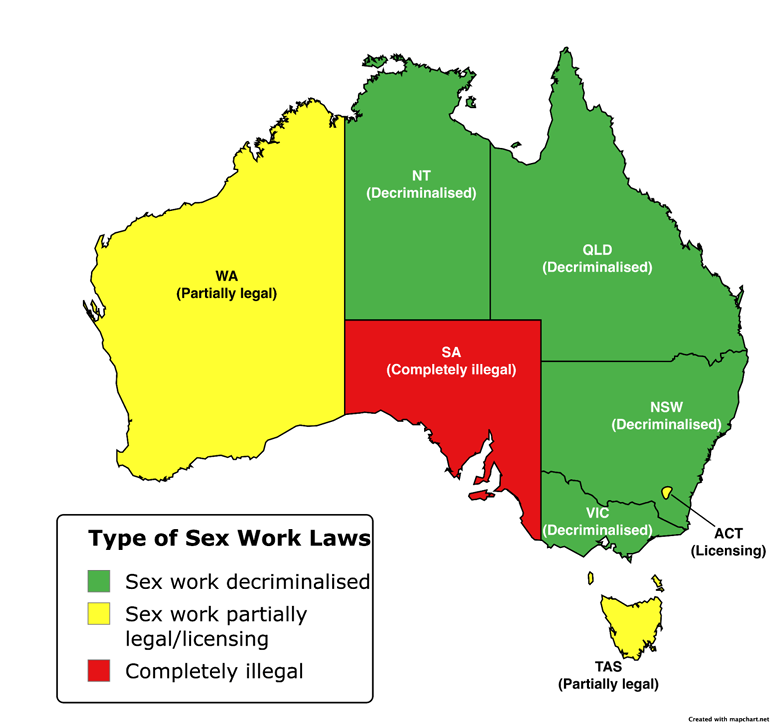
Where is Sex Work Decriminalised in Australia?
Sources and Notes
- Western Australia’s laws partially legalise sex work. See the Prostitution Act 2000 (WA)
- In South Australia all forms of sex work are illegal. See Summary Offences Act 1953 (SA) and the Criminal Law Consolidation Act 1935 (SA).
- Tasmania’s laws partially legalise sex work. See the Sex Industry Offences Act 2005 (TAS)
- Victoria decriminalised sex work in 2023. See the Sex Work Decriminalisation Act 2022 (Vic).
- The Australian Capital Territory partially legalises sex work via a licensing system. See the Sex Work Act 1992 (ACT)
- New South Wales mostly decriminalised sex work in 1995. Various state laws apply.
- Queensland decriminalised sex work in 2024. See the Criminal Code (Decriminalising Sex Work) and Other Legislation Amendment Bill 2024 (QLD).
- The Northern Territory decriminalised sex work in 2020. See the Sex Industry Act 2019 (NT).
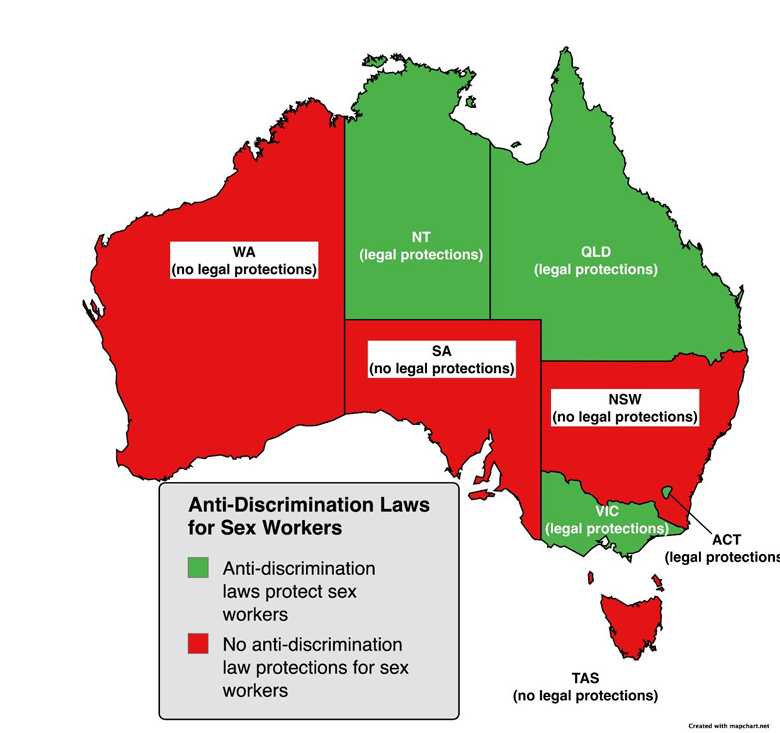
Anti-discrimination Laws for Sex Workers
Sources and Notes
- Western Australia, South Australia, Tasmania and New South Wales have no anti-discrimination laws to protect sex workers.
- Victoria protects sex workers and others working in the sex industry from discrimination via the protected attributes ‘profession, trade or occupation’ and ‘lawful sexual activity’. See the Equal Opportunity Act 2010 (Vic).
- The Australian Capital Territory protects sex workers and others working in the sex industry from discrimination via the protected attribute ‘profession, trade or occupation’. See the Discrimination Act 1991 (ACT).
- Queensland protects sex workers (but not others working in the sex industry) from discrimination via the protected attribute ‘sex work activity’. See the Anti-Discrimination Act 1991 (QLD).
- The Northern Territory protects sex workers (but not others working in the sex industry) from discrimination via the protected attribute ‘employment in sex work or engaging in sex work, including past employment in sex work or engagement in sex work’. See the Anti-Discrimination Act 1992 (NT).
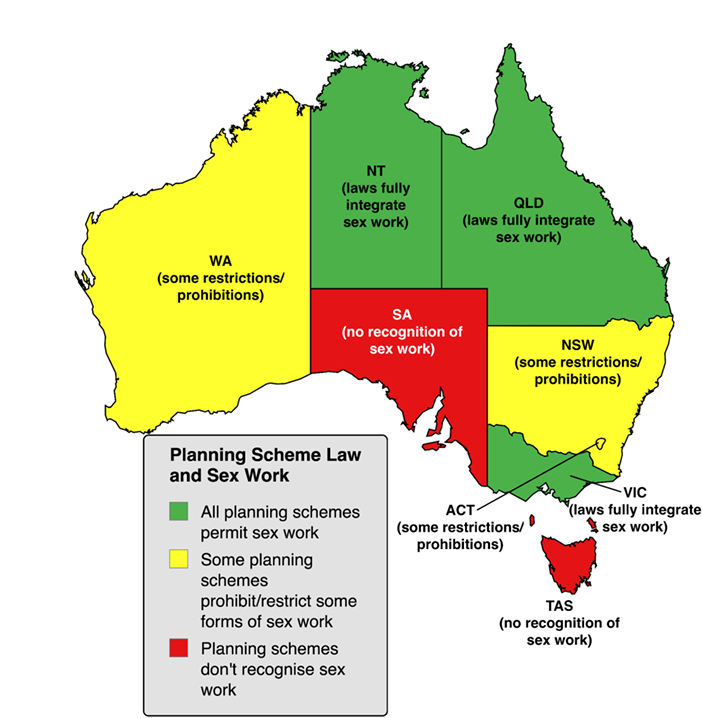
Local Government Planning Scheme Laws
Planning schemes regulate commercial activity on private land. They are enforced by local councils. Each state/territory has many different local councils, each with its own planning scheme. Some jurisdictions give local councils the power to restrict or prohibit some forms of sex work.
Sources and Notes
- As sex work is illegal in South Australia, planning schemes do not recognise sex work.
- Despite mostly decriminalising sex work, different councils across NSW can prohibit sex workers or sex work businesses from certain areas. There are no uniform sex work planning scheme laws in NSW.
- Victoria has decriminalised sex work and planning schemes statewide treat sex work in the same way. All the planning schemes treat sex workers exactly the same as hairdressers. Councils may not introduce local laws which discriminate against the sex industry. See the VC217 Planning Amendment.
- The Northern Territory has decriminalised sex work and has planning schemes which permit sex work. See the NT Planning Scheme 2020.
- Queensland decriminalised sex work in 2024. Although planning schemes vary across the state, councils in Queensland must not create extra or special rules for sex work businesses. See the City of Brisbane Act 2010 (QLD) and the Local Government Act 2009 (QLD).
- As sex work is not decriminalised or licensed in Tasmania, planning schemes do not recognise sex work.
- Western Australia has not decriminalised sex work. Planning schemes vary, and may prohibit some forms of sex work.
- The Australian Capital Territory has sex work licensing laws. Planning schemes vary, and may prohibit some forms of sex work.
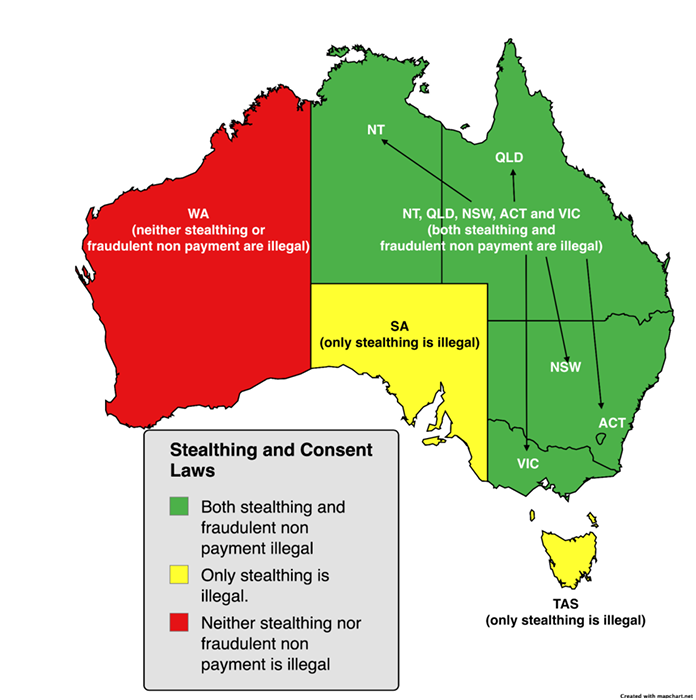
Sexual Consent/Stealthing Laws
The non-payment (or partial payment of service fees) and stealthing (deceptive removal of a condom) are some of the most common crimes committed against sex workers by clients. Sex workers therefore call on all jurisdictions in Australia to criminalise stealthing and the non-payment of service fees to sex workers.
"Sex workers clearly fall into the category of vulnerable workers in general and may be particularly vulnerable to abuse of this kind. Certainly, no one should doubt that fraudulently achieving sexual intercourse by this kind of activity constitutes rape…” [9]
Judge Penfold J Tweet
Sources and Notes
- Since 2022, stealthing has been a crime in Victoria. The fraudulent non payment of sexual service fees has also been a crime since 2022. See the Crimes Act 1958 (Vic).
- Stealthing is a crime in New South Wales. The fraudulent non-payment of sexual service fees is also a crime after Mr Harjeet Singh Saini was convicted and imprisoned for six years for fraudulently not paying for sexual services. See the Crimes Act 1900 (NSW).
- Stealthing is a crime in Queensland. So is the fraudulent non payment of sexual service fees. See the Criminal Code Act 1899 (QLD).
- Stealthing has been a crime in Tasmania since 2022. Sex work is partially criminalised in Tasmania and there is no law against the fraudulent non payment of sexual service fees. See the Criminal Code Act 1924 (TAS).
- Stealthing has been a crime in South Australia since 2023. Sex work is completely illegal in South Australia and there is no law against the fraudulent non payment of sexual service fees. See the Criminal Code Act 1924 (TAS).
- Since 2019, stealthing is possibly a crime in the Northern Territory. It is possible that the fraudulent non payment of sexual service fees is also illegal. See s10 of the Sex Industry Act 2019 (NT)
- Stealthing is not illegal in Western Australia. Sex work is partially criminalised in Western Australia and there is no law against the fraudulent non payment of sexual service fees.
- Stealthing has been a crime in the Australian Capital Territory since 2021. There is case law demonstrating that the fraudulent non payment of sexual service fees in the ACT is a crime. See the Crimes Act 1900 (ACT) and R v Livas [2015] ACTSC 50, [1], [39], [41].
- Sentencing remarks by ACT Supreme Court judge Penfold J. See R v Livas [2015] ACTSC 50
Further Reading:
Macquarie University Law Society, ‘Sex Workers and Consent: Unblurring the Lines’
Information sheet about Victoria’s planning scheme and sex work
Artificial intelligence was not used for the text, charts or images on this webpage.
Last updated: 18 March 2026